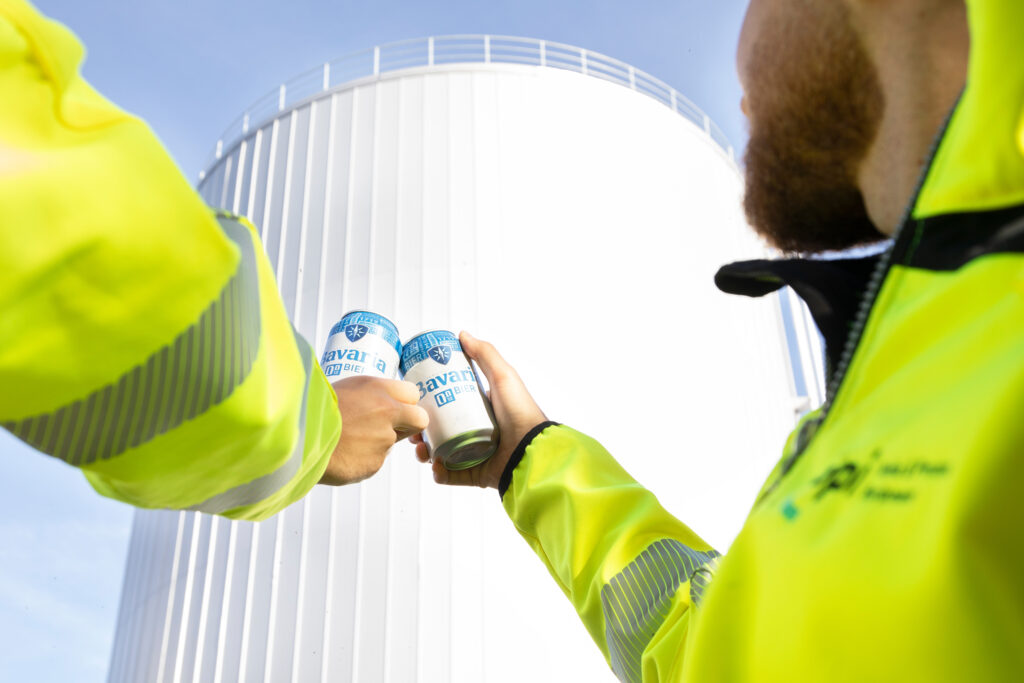
Holland Malt is a subsidiary of the family-owned company Royal Swinkels, renowned for producing beer and artisanal soft drinks, including La Trappe specialty beers, Palm, Cornet, and Bavaria beer. Holland Malt specializes in producing malt, the essential ingredient for these products. Recognizing the energy-intensive nature of malt production, the malting facility aimed to reduce its energy consumption. Consequently, the company initiated a sustainable project in 2021 with the objective of achieving a 100% emission-free malting facility by 2024. To accomplish this goal, various tanks for heat recovery were required. Holland Malt approached Gpi Tanks and Gpi Tanks XL for engineering and building these tanks.
Sander Berger, Project Manager at Royal Swinkels, was involved in the entire project. Sander explains the rationale behind the project: “Holland Malt is a malting facility that has been producing malt in the Eemshaven since 2005. Malt is used as a raw material for beer and whisky. In the production of malt, grains are first steeped and then germinated. Subsequently, it is dried to produce malt. Drying requires a significant amount of energy to evaporate the water, presenting an opportunity for sustainability. We embraced the challenge of becoming the world’s first fully emission-free malting facility. Our motto: if we do it, we do it right. With this step, we have completely eliminated our reliance on gas.”

Choosing Gpi
Two projects
Gpi Tanks XL supplied two 1800 m3 stratification tanks made of lean duplex 1.4162 and 1.4062. In these tanks, water is stored at constant temperatures of 72°C and 95°C. Sander explains: “Large heat pipe heat exchangers are now installed where the old gas burners used to be. Hot water flows through these to the stratification tanks. With the help of a heat pump system, these temperatures in the tanks remain virtually constant. We utilize the heat from these tanks to bring the drying air to the required temperature.”
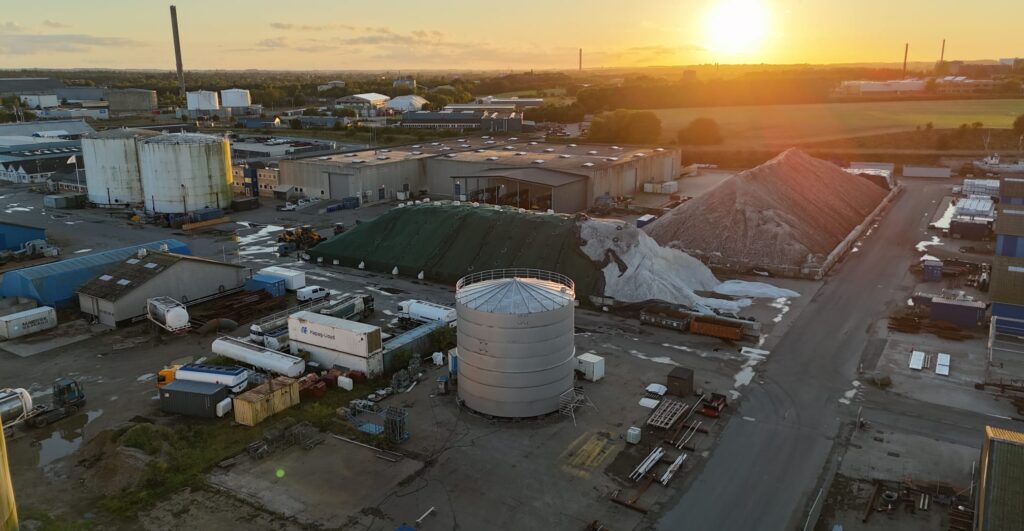
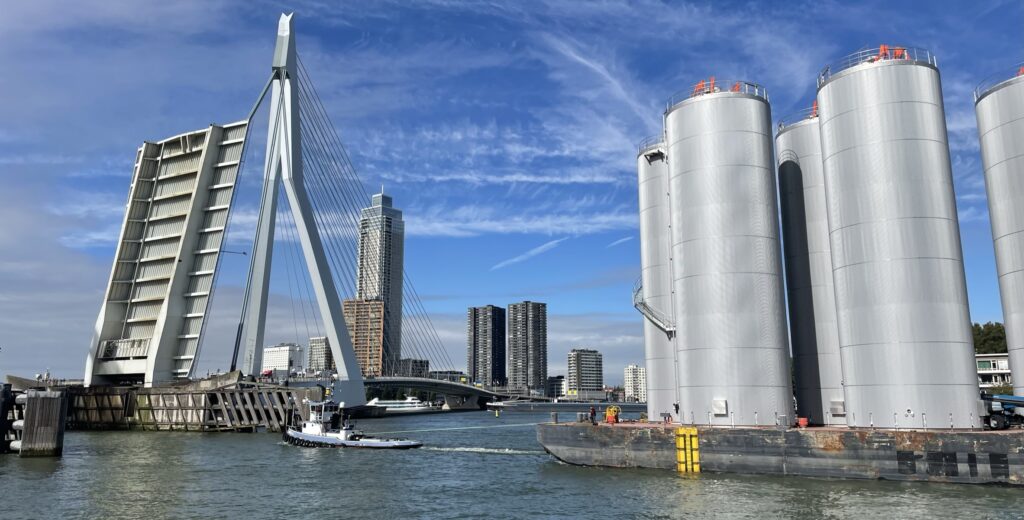
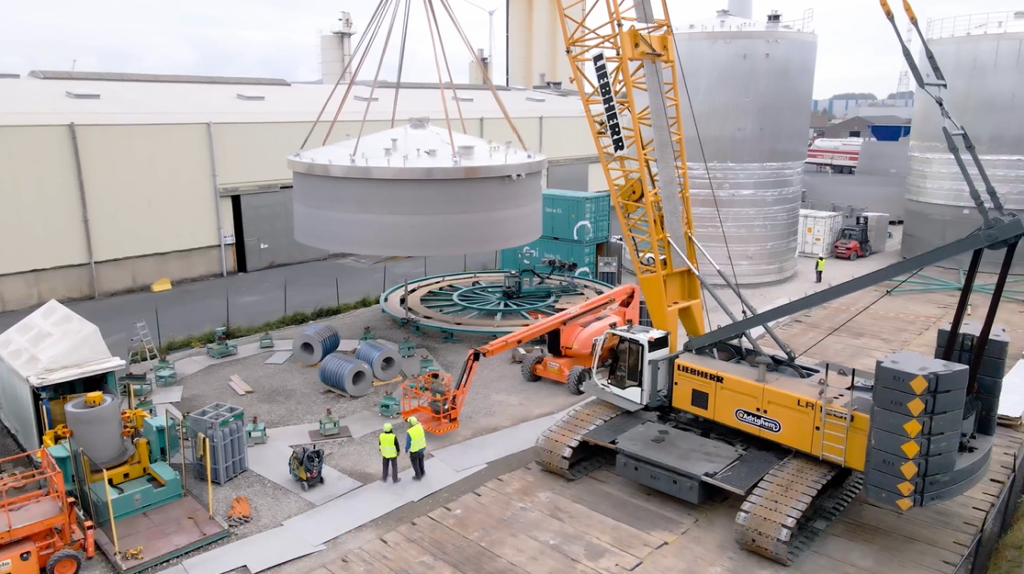
Gpi Tanks supplied three large innovative stainless steel tanks for heat recovery. These tanks were manufactured in the production facility in Groot-Ammers and transported to the Eemshaven via waterway. The 1800 m3 duplex tanks, measuring 16 meters in height and with a diameter of 12 meters, were constructed on-site near the malting facility in the Eemshaven by Gpi Tanks XL. They were then hoisted onto their permanent foundation using large Mammoet cranes, a complex operation that took several hours despite the short distance.
The collaboration
Sander is enthusiastic about the tanks and the collaboration with Gpi: “During the construction of the large stratification tanks, we encountered several challenges, but I am pleased with the outcome. I found the collaboration with Gpi Tanks to be very enjoyable, just as I expected from Gpi. We were able to brainstorm together and came up with great solutions. It was rewarding to sit down with everyone involved and have open discussions. When everyone contributes their ideas, the best solutions emerge. That’s exactly what I expected from Gpi.”

The result
With the reuse of their own waste heat, Holland Malt took a significant step in the energy transition. The tanks are an essential component of this new heating system. Combined with new heat pumps and green energy from wind and solar power, malt production will be completely emission-free from 2024. This results in a gas saving equivalent to the consumption of 14,000 households. Sander explains: “With our new innovative heating system, we do not use fossil fuels, biomass, or other energy sources that produce harmful emissions. We are the world’s first emission-free malting facility.”